Sunday, 20 May 2012

Kyoto artDive #06, Art Festa with a high cuteness factor


Miyako Messe seems to offer Kyoto quite some different events to replenish the cultural and creative hart. I've attended a traditional crafts fair, kimono exhibition, and an antique books fair was held I wanted to attend to. This weekend, Kyoto Art Festa was held, the 6th artDive. Personally I'm not completely sure I would call the works on show art. But at least a lot of creative minds game together and offered a whole range of kawaii (Japanese for cute). For art with an 'A' I would recommend ART Kyoto. See my article about this event here.

Whatever the term used, it doesn't matter. There was something for everyone at artDive #06 with 220 booths and 330 creative people selling their works. There were paintings, 3D art works, jewelry, T-shirts, candles, wind chimes, wood craft, bags, furniture and lot's of illustrations! There was even an ARTs*LABo Postcard Exhibition, with 1000 postcards to choose from. So everyone literally could take home a little piece of art. Next to the Postcard Exhibition was the 'Sakura Exhibition', showing 230 Cherry Blossom pieces. A project to market and attract more international interest to the young and upcoming artists. Japan would like to attract the worlds attention to their artistic talent as Japans cherry blossoms already do. It was a great showcase of Japans illustration talent!

The talent on showcase was wonderful but I would have liked to see a bit more 'cool' and attitude. A big fan of kawaii articles myself, I wouldn't have minded for diversities sake to see some vinyl toys for instance or more booths with big art works. This time the girly girls ruled big time with small works, I hope autumn will deliver a little more 'swagger'.

Apart from art work already finished, Live Paint Booths gave a very interesting view on the creators method of working. Which was completely different for all of them. I especially liked that the booths were so conveniently placed opposite the artDive café. A perfect place to enjoy a B.L.T. and ice coffee and watch the art works come to life.

If you missed the artDive on May 19th and 20th, you don't have to wait for a year. The next will be held this autumn, October 20th and 21st. Would you like to go, here's a link to the website.

Thursday, 17 May 2012

See Kyoto's maiko & geisha dance and get a glimpse of their mysterious world


Kyoto knows five geisha districts, namely Miyagawa-cho Kabu-kai, Ponto-cho Hanamachi, Gion Kobu, Gion Higashi Kabu-kai and Kamishichiken Kabu-kai. Geisha are formally called, geiko and apprentice geiko are called maiko. Each one of these districts in Kyoto have their own theatre where geiko and maiko perform their elegant dances every year. Four of the performances are held in spring, one in the fall.

At none of the stages it is allowed to take pictures unfortunately. But outside the theaters, in the geisha districts, there are enough chances to see maiko and geiko rushing to and from the theatre. You must be quick though, most are in a rush and are not really inclined to stand still for long. They are working of course, so don't try to stop them for your convenience of taking their picture (as many tourist would like to or maybe tries). If you are lucky some maiko and geiko attend the theatre as spectators themselves and meet friends or acquaintances in front of the theatre where you can snap them more easily, if you like to do so.

Dance performance at Miyagawacho Kabu-kai
The picture's above were taken at geisha district Miyagawacho Kabu-kai. The one picture of the stage is from "Kyoto Visitors Guide'. The spring dance of Miyagawacho is called the "Kyo Odori" (Kyoto Dance). The first performance was held in 1950 and enjoyed great popularity since then. After the fifth performance the stage was moved temporarily, but in 1969 the new Miyagawa-cho Kaburen-jo Theater was completed and the dance returned to its original location.

The dance is preformed only in the first two weeks of april. Tickets are quite easily obtained from the ticket office in front of the theatre. If you get there early in the morning to buy the tickets, you have more choice where to sit. The performance shows famous places and stories of Kyoto as a background. Traditional music will be played live on stage by the musicians. Not only dance, but some theatre, or musical-like performance, will be shown as well. Even some of the performers will dress up as men to play the roles necessary for the story. Which is a comical and strange sight knowing a very elegant and sophisticated girl is underneath the 'pomp' and 'swagger' the role of men ask for. The best part of the show is the end dance where every performer comes on stage and they dance all together in their colorful kimono using fans to emphasize their elegant movements.

Dance performance at Ponto-cho Hanamachi
The dance is called Kamogawa Odori (Kamo River Dance) and started in 1872 as part of the Kyoto Exposition. It has been performed annually since and provides a show with a wide range of fans. This is the last spring dance event, from May 1st -24th. So there is still a week to attend it this year!

Dance performance at Gion Kobu
The First performance, called Miyako Odori (Dance of the Capital), was held in 1872 to  the Exhibition for the Promotion of Domestic Industry. Kyoto struggled hard after the capitol of Japan was moved to Tokyo in 1869. Although the performance has a long history, each year the dance is different and this has made it very popular. Held from April 1st - 30th.

Dance performance at Gion Higashi Kabu-kai
The dance is simply called Gion Odori (Gion Dance) and was first performed in 1953. The dance is known for for its original planning and composition. This performance is the only one in autumn and held from November 1st - 10th.

Dance performance at Kamishichiken Kabu-kai
The performance is called Kitano Odori (Kitano Dance) and officially begun 1952. The Kitano Club and the Mando Club danced jointly in commemoration of the 1050th anniversary of Kitano Tenman-gu Shrine. It is known to be both elite and tasteful. Held from April 15th - 25th.

Tuesday, 15 May 2012

Midosuji Festa, 10th anniversary of Osaka's Street Fair


Osaka celebrated it's rich culture this week with a 10th anniversary party of the Midosuji Open Festa, known in short today as the Midosuji Festa. The aim of the organization of this very busy street fair is to attract more visitors to Osaka as a whole and to the Midosuji Avenue and Minami neighbourhood in particular. An 'urban regeneration' is what they call it. Minami and Midosuji though are very different neighborhoods. Midosuji Avenue represents the high end visitor with all the big brands and their flag ship stores like Chanel, Louis Vuitton, Marc Jacobs, Cartier, Hermès and Dior. Minami attracts a younger, more urban public. There you'll find the new trends, or shops for all kinds of subcultures, but also clubs, small restaurants and izakaya.

But maybe when it comes to open air street fun, like music, dance, art, fashion and sports, the public is not so different! Last year the Festa was flooded with 370,000 visitors. I would not be surprised if the Midosuji Festa 2012 attracted even more. The Festa sure could count on the weather for support, it was a great 21 °C, a prefect day for a street fair. The downside of these perfect conditions, not surprisingly, are the huge numbers of visitors. All dance, sports and music performances were on street level, not on a podium. That way everyone crowds around, so if you're not on the front row, tough. If you have a preference to see something, try to find a spot beforehand and stick with it. It would give you the chance to then see all the dance performances, or all sports performances for instance. Because those are all held continuously through the day, by different groups.

I would recommend the dance groups. They are always so very energetic, happy and colourful! The groups consist mostly of very young dancers to sometimes quit old and they are with many. Several play their own (small) instruments or shout out yells to the music. See at least a show or three, you're in for a superb spectacle. The sports performances differed greatly, but all had their own appeal. Some funny (basketball), some exiting (tae kwon do), and some awe inspiring (karate). If you like to take it low-key, watch a fashion show, or go to the 'beauty salon' where you can have your hair or nails done. Why not?! All in all, the day had a very positive and happy vibe.

Sunday, 13 May 2012

Ohara-me festival celebrates the strong women of Ohara


In the north of Kyoto, in Sakyo Ward, lies a pitoresque mountain village called Ohara. Very much in the rural area, the lives of the inhabitants of Ohara is still for the most part about farming. The women of Ohara are famous for it even. Wearing traditional farm clothing, they are called 'Oharame'. These women come to the city of Kyoto still today, selling mostly vegetables and sometimes flowers. Nowadays they use pull carts, but mostly small trucks. In earlier times the women carried their loads on their heads.

As part of the Aoi festival, from May 1st till May 15th, lost of festivals (matsuri) are celebrated all over the Kyoto area, every day. At Ohara on May 12th, the girls and women of Ohara wear their traditional costumes, stemming from the Muromachi era. From the very young to the old, they are all proud of their ancestry. The Oharame walk in procession through their village starting at the Shorin-in (temple). And since Ohara is not only famous for it's strong women, but also for their many temples, the procession get's a beautiful and ancient background. One of the most famous temples of Ohara, Hosen-in is included in the tour too. The procession ends after two kilometers, at the Sanzen-in temple. At the starting point, however you'll get ample time to take pictures. There is even an official moment to take a group portrait. Which a lot of beaming grand-parents do!

Furthermore Ohara has a charming shopping street up the mountain where local products are sold, like pickles, jams, wooden and leather wares, furoshiki and more. But the most beautiful about Ohara is just strolling around, walking through the mountainous landscape and savour the view.

Thursday, 10 May 2012

More spectacle on Boy's Day, with horseback acrobatics at Fujinomori Shrine


Aoi festival part II, Children's Day on May 5th. This time a little way of the beaten path, I visited Fujinomori Shrine as part of the Aoi festival celebrations. Fujinomori Shrine is over 1200 years old, so it was built even before Kyoto became the Imperial capital in 794. The deity of the shrine is connected with military arts and war. Members of the imperial family and leading samurai warriors have always worshiped at this shrine.

Surprisingly a completely different atmosphere is present today. The visitors of Fujinomori in Fushimi Ward are very much the 'ordinary' man and woman, and child so to speak. May 5th is Children's Day after all. Therefore lot's of game and play for the little ones. Like target shooting, playing with goldfish, turtoises and crabs, to take home whatever you can grab. Not the average kid's entertainment in the Netherlands and I'm happy for it. The rest of the amusement was all very responsible and fun. All kinds of food stalls didn't miss on the premises, it is Japan after all. The whole set up gave it a bit of a carnivalesque feel and with it's absolutely great weather is was a fun day 'in the south'.

May 5th is also known as Boy's Day (March 3th historically became Girls Day). Weeks before Boy's Day streamers in the form of a carp, koinobori, can be seen throughout Japan. The bigger the carp, the older the son. Carp are a popular Japanese symbol because they are admired for strength and their determination to swim upstream. These qualities are what parents hope for in their children.

Boy's Day is celebrated at Fujinomori Shrine with a festival called Kakeuma Shinji or Fukakusa Matsuri. Spectacular stunts are shown while riding a horse, techniques deriving from the battlefield of samurai. Samurai in their day had to be able to ride their horse through enemy country, but also try not to get shot! Well, why not hang yourself by the side of your horse, stand on it's back on your head or sit backwards on it so you can shoot arrows at your pursuers. Where Shimogamo Shrine showed Yabusame Umashinji earlier in the week (shooting arrows from horseback), this time it was about the acrobatic moves. I'm glad they don't combine the two nowadays, because also this ritual is not without danger. The last horseback rider at Fujinomori fell while performing his last trick. And this time the rider did not stand up. Up till now I'm not sure how he's doing. It is not something unheard of, participants or spectators getting hurt or even dying during the performance of a ritual stint. So whatever you do at times visiting a spectacular festival, personally I would advise not to take the front row...

Tuesday, 8 May 2012

Spectacle and courage; Mounted Archery at Shimogamo Shrine


The first week of April is called the 'Golden Week'. It got it's name from the fact that this week Japan experiences the highest peak in commerce, because supposedly 127 million Japanese get to have the week of. There are already 4 national holiday's during this week, and why not take an extra day or two and have a whole week of freedom? So a Golden Week it is, for retailers, as well as holiday makers. And there's plenty of events to choose from where to spend your time (and money).

On May 3th I went to see a very spectacular event at the Shimogamo Shrine in Kyoto, where very brave men perform archery on horseback called Yabusame. The ritual can be dated back to 300 BC. The event on May 3th is part of a period of the Aoi Matsuri (Hollyhock festival) that lasts two weeks. To watch this actual event, one need a liberal dose of patience, but it get's rewarded generously also. If you would like to visit this event next year, get there at 11:30 a.m. (the event starts at 1 a.m.) and queue for a ticket. If you don't want to stand for 3 to 4 hours, first to get a good spot and then through the whole event, you have to get there early. First all officials and archers ride past the spectators a few times. This takes a while, but when the ceremony is done, the actual spectacle starts. There are three targets where the archers aim their arrows, so it's even nicer to sit directly in front of one of those. Not without danger to oneself though! The space between the mounted archers and the spectators is a mere 3 to 4 meters. The archers shout an impressive 'In-Yo-In-Yo!', darkness and light, and thunder past on their horses at high speed, mud flying everywhere!

It was very clear how terribly dangerous and difficult this ritual actually is. Not very often all three targets on the 255 meter long track were hit by an archer. To hit all three is therefore considered an admirable accomplishment. But hitting the targets is not the only concern of the archers. One of them, aiming for the second target, fell from his horse at full speed! In shock I totally forgot my camera and was very happy to see he stood in just seconds and walked. He even got back on his horse and did another few runs! He was a bit disheveled, but he was the hero of the day. To be selected as a Yabusame archer is a great honor and he did right to his status. The other archers did have quite a bit of difficulty hitting the targets also, but when they did, it was under loud cheers.
Around 800 years ago, mounted archery was used to train samurai and keep them prepared for war and the archers who performed poorly could be ordered to commit seppuku (known as ritualistic suicide)! And dogs should also be grateful, since it was common to use them as a target first... Just as well it's 2012!

Saturday, 5 May 2012

Shodō, the Way of Writing


Shodō literally means 'the way of writing' in Japanese. And this ancient Japanese calligraphic art has it's roots in China. Because still today kanji (the Japanese characters) used in Japan are the same as the characters in China. They only sound different.
The Japanese have three alphabets today, hiragana, katakana and kanji. Hiragana is a simplified script that is used to write every 'sound' and there are 48 of those characters. Katakana resemble hiragana, but are used to write words that stem from other languages. There are 51 katakana characters. Kanji however indeed depict whole concepts sometimes and had a long way to evolve from their origin 8000 years ago. Chinese characters came to Japan in 57 AD. You need to learn 2000 to 4000 kanji to be 'literate' in Japan. Which means you can read the newspaper. There are however, tens of thousands of Chinese characters in existence.

If you look at the older scripts from China, you can see they're actual drawings. And this is what Shodō masters do, taking the oldest found scriptures, written in bones or bronze vases and 'copy' those and make them into an art form. You could rather say Shodō artists 'interpret' the scriptures, like classical music is interpreted by master musicians.

To learn Shodō, an apprentice starts imitating the master. At school children still learn Shodō and do this by imitating the scriptures in the Shodo textbook. Taking Shodō lessons means imitating the sensei's (teacher's) work. Advanced artists imitate the works of famous Shodō artists from centuries ago. Artist first master the imitating and then add their own creativity.

Visiting the Shodō exhibition of the Tokyo based Kikkokai Group, lead by Shodō master Koho Kato, was a great experience. (Kato san is seen on the picture left, also in front of his own work.) The works were all explained to me in English by a very friendly member and artist, mr. Issei Joshihara. He was exhibiting his own work also, and is seen on the photo (right) in front of a fragment of an ancient Chinese scripture made in bronze hundreds of years old. I have a great esteem for Shodō and it's masters. Being very interested in typography because of my graphic design background, Shodō is the ultimate expression and source of knowledge and artistry in my opion.

The Kikkokai Group exhibited for the first time in Kyoto, at the Kyoto Prefectural Centre for Art and Culture. I was very impressed and felt lucky to have found the exposition! The time unfortunately is short, just a week, but a Golden Week!

Wednesday, 2 May 2012

ART KYOTO 'Making Kyoto an art tourist city'?


Last weekend Kyoto was the base of national young contemporary artists. Two main venues and nine galleries participated in a new event that has come to Kyoto three years ago. All the participating locations where spread throughout the city, but handily never far from the stations of the Karasuma subway line. The quality of the work was high at the main venue, the Kyoto International Conference Center, and I would have liked to see more of it! To my surprise I was allowed to take pictures, which strangely enough is not a given in this photo-crazy country, so this really made my day!

A kokeshi collector myself, one of the interesting projects was by Tsunao Okumura. Day-in-day out he's carving away at the faces of vintage traditional kokeshi to remove all the colour. And he even kept all the shavings in a jar was revealed to me by the gallery owner. Another project that got my attention is called 'New World Transparent Specimens' (top right) by Iori Tomita. As the artist states on his website: ''People may look at my specimens as an academic material, a piece of art, or even an entrance to philosophy. There is no limitation to how you interpret their meaning.'' And these are just two of the fascinating art works on show at this venue alone. The other main venue, Hotel Monterey had works on show a little less high in quality, but was not less interesting! I could even call it 'quirky', but in a good sense. Two floors of the Monterey were occupied with Art Kyoto, in each hotel room a different gallery. The art stood, hung and leaned against the hotel beds, night stands and dressing tables. Even some galleries used the bath and lavatory to show art works. The event being bustling with art lovers, going in and out of the rooms took some squeezing and patience. But I applaud the creativity of it, the quirkiness and fun it gives to this new event in town! So let's hope Art Kyoto will show you again in 2013 what contemporary Kyoto has to offer, specially if it is on a toilet bowl!

I might not be unfair to say that Art Kyoto might have looked for inspiration to the Art Fair Tokyo. But what Tokyo does internationally, Kyoto wants to achieve for their domestic talent. The aim is not so much to develop a market for Japanese contemporary artists outside Japan, but what it rather wants to achieve is to create interest from the national art market. I understand is has been quite hard to attract attention to contemporary art as opposed to traditional and modern art, specially in Kyoto.
This year Art Kyoto was able to attract over a 100 galleries. Two years ago the organization brought together 35 galleries, so this event is growing quickly! And it's not a coincidence it is set in the first weekend of the Golden Week, the busiest week of the year for Kyoto. Let's hope a big chunk of all those tourists coming here went to see the up and coming of contemporary Japan at Art Kyoto 2012.

Sunday, 29 April 2012

Six weeks of blossom viewing, breathtakingly beautiful

This is the fifth time I'm visiting Japan, but the first time I had the opportunity to really watch the spectacle and metamorphosis of the land and it's people during blossom season. To take it all in, at least I had all the time in the world this year round and made 16 trips to watch this famous spectacle!

And just as well, I took about 400 photo's starting from March 14th when the plum blossom (ume) started blossoming until just yesterday I took some pictures near my home of some late blossoming cherry trees (sakura). And there are still trees that won't give up and spread their wealth of flowers and perfume!

It might seem the blossom season only lasts one week, the first week of April is one of the busiest times in Kyoto most years, but I found the season can take up to eight weeks. Depending on the weather of course and the region you're in. Another fact I was not aware of is that, for instance, Tokyo is way ahead of Kyoto when it comes to the timing of the blossoming trees, although Tokyo lies 465 km (288 mi) farther north. Well, there you go, traveling up from the south of Japan up north to the beat of sakura isn't even all that simple!

During the past six weeks I learned some more about blossoms. It seems 'ume' for the Japanese is not as breathtakingly thrilling as sakura is. As I was informed by a Japanese lady that sakura season was coming up, I enthusiastically showed her the pictures I already took at the Zuishin-in during the Hanezu Odori Dance. She was not impressed, because these showed plum blossom, not cherry blossom. Well, that's one lesson learned. I was indeed a bit surprised by the vigour the Japanese show at seeing one tiny petal of sakura. They immediately flip out their mobile phones or swoop in with whole kitchen steps and professional bags full of lenses to get the right angle. But, I must admit, after a few 'Hanami' trips I am taken by the sakura-fever too! (Hanami literately means 'flower viewing', and than means cherry blossom in Japan as we've learned now).


I rated the trips I made by the best blossom viewing:
1. Miho museum in Shiga. I went there two times even, because the first time it was too early for the blossom as it turned out. The second time I got rewarded with a sea of bright pink. The Miho museum strangely enough is not well known, even by the Japanese, so there were almost no other visitors (at 10:00 - 11:00 am). which, in a way is a goo thing when you go blossom viewing! Here's a link to my earlier Miho Museum article. On the way back from the museum (by car) I passed the little town of Ritto and was treated on a wealth of sakura lining the river! (1b)

2. Near Ashiyagawa station at Ashiya, west of Osaka. Tranquility and pleasantness, at the peak of the sakura season. Seat yourself on the grassy banks of the river, and hear the water flow while your eyes are on the sakura and the mountains above. Pure bliss.

3. Along the river between station Shukugawa and Koroen station in Nishinomya, west of Osaka. A wonderful place, a great photo opportunity. However, far more crowded than Ashiya, but very beautiful nonetheless.

4. Along the Kamogawa River, near Kyoto Botanical Garden. An oasis to spend a day and have a picnic, even without sakura! The cherry trees reach as far as the eyes can see, both ways. Note that the darker pink weeping cherry trees, along Nakaragi-no-michi path, blossom a while later in the season.

5. Kiyomizudera and Higashiyama (5b), including San-Mon Gate (5c) in front of Chion-in in Kyoto. The neighbourhood around Kiyomizudera is one of my favorite places to stroll through. There are a lot of easy photo opportunities here, also with lovely kimono clad girls (ask nicely and they pose for you!). Sometimes you even meet maiko-henshin (tourists that are dressed up for the day as maiko, which is an apprentice geisha). Note that Higashiyama is also one of the busiest places in Kyoto, so go really early. The views from Kiyomuzudera over the mountain beneath dotted with sakura trees is beautiful.

6. Zuishin-in in Kyoto (ume blossom), during the Hanezu Odori Dance. The temple is known for it's 'Hanezu Plum Trees', hanezu meaning a light red colour in Japanese. It's one of my favorites , because of the dance event and I happen to love ume. Plus it were the first trees blossoming in Kyoto and has great photo opportunities, also of other photographers! Here's a link to my earlier article about the Zuishin-in Plum Blossom Festival.

7. Honryuji Temple at Kyoto. The perfume these trees radiate is enormous! A very special, quiet place where you'll probably only meet one or two other photographers, even at the peak of the sakura season.

8. Philosophers Path (Tetsugaku no michi) at Kyoto. I went two times as it is one of the most popular spots. As it turned out it is really hard to time well with sakura, because the neighborhood around Philosophers Path was teeming with blossom, the Patch itself was barren, showing a wintery scene. Not much fun. A few weeks later, when I went back, it was a bit too late for sakura. However it is a very pleasant path once the trees have their foliage and I would definitely recommend a stroll on a beautiful day!

9. The north side of Keage (station) at Kyoto. From the old Boat Railway and Lake Biwa Aquaduct Museum, that show many sakura trees. Then take the Shishigatani-dori and feel yourself enveloped by ancient Kyoto with numerous temples along the road, dotted with sakura trees here and there. This road leads to Philosophers Path.

10. Kitano Tenmangu Shrine. An amazing place which I later will make a post about. But I was not there when the sakura was at it's best so I can't really tell about that. But even without sakura the temple complex feels mystical and has an ancient atmosphere, be sure to not miss it while in Kyoto.

11.Tō-ji Temple in Kyoto. I was there during the famous antique market at the end of march. It's my favorite market here, and I was treated on some beautiful ume, but the temple doesn't have many ume trees.This link shows my earlier pictures at Tō-ji Temple. You'd maybe better go during the blossoming of sakura (I haven't been there at the prime time).

12. Kodaji-in at Kyoto. Beautiful garden, specially during the light festival it's worth a visit. But, it has only one sakura tree, so don't expect more than that.

13. Jonan-gu Shrine in Kyoto. Plum tree & Camellia festival. Nice, but challenging photo opportunity. I would advise to go early March, for the Camellia. These and ume do not peak at the same time, so it's difficult to see both at their best.

14. Sakura at Maruyama Park and Yasaka Shrine at Kyoto. This was the biggest disappointment, shock even, of the sakura season! An unparalleled commercial event. It's outrageously popular among the Kyotites for Hanami picnics, taking with them huge amounts of blue plastic and there are loud coloured food stalls everywhere. Yasaka shrine is supposed to be a popular sakura spot, but I thought the sakura was almost non-existent. You better visit Maruyama Park before or after this 'craze' of Hanami picnics.

Apart from the last entry, looking back at these last few eeks, it was all quite impressive! The hardest thing about Hanami was, naturally, that blossom trees don't flower at the same time. And it's very difficult to predict when they are at their best at which location. I found sometimes I was too early and sometimes too late. Ah, nature is unwieldy… I'm keeping my fingers crossed I can 'Hanami' another time!


Friday, 27 April 2012

One of my most treasured experiences in Japan, Miho Museum


Miho, a museum worth a visit for the architecture and the location alone, apart from the collection. Maybe not so strange considering one of the world most famous architects designed it, namely I.M. Pei. The same Pei who designed the glass pyramid of the Louvre in Paris for instance.
With respect for the beautiful nature of the mountains surrounding Shigaraki, the Miho museum is designed so 80% of it is built below ground. Which, strangely enough, isn't really noticeable when walking around. It rather feels light and airy with it's wide spaces, glass roof and big windows. M.I Pei incorporated the Japanese thinking, culture and traditions into the design of the museum and took the old 'Tale of the Peach Blossom' as an inspiration.

The museum building is separated from the parking lot and ticket office by a long tunnel and a bridge. For people less able to walk a 'golf cart-like' shuttle service runs continuously between the two buildings. But walking is preferable, so you can savour the beauty of the tunnel and the cleverness of the bridge, and take in the splendid view on the museum itself. The views from inside the museum to the other side of the mountains will increase your excitement. As a great addition to your visit, take lunch at the Pine View Tea Room with a gorgeous view on a 'private' pine garden. The lunch, however limited the choice is, will give your taste buds a surprise.

The location of Miho musuem is absolutely amazing, but be sure to enjoy the 50 minutes drive from Ishiyma station through rural Shiga also. The road runs along a stream in the mountains and the surroundings are gorgeous (take a seat on the right side of the bus!).
To be able to enjoy the landscape to it's maximum beauty, I would advise to visit Miho museum late April or even later in the year. That's also the time the cherry trees will be at their most beautiful. In early spring, many trees on these mountains, and on the premises of Miho won't have their foliage yet. This takes away some of the beauty, although the sights will still be stunning even so.

I visited Miho museum three times. The first time it was already one of the most memorable experiences I had in Japan and it still is today. The first time it was autumn, which was absolutely amazing with all it's vivid colours. The second time was April 15th this year, and a little too early for the cherry blossoms. Consulting Miho's online sakura report I decided to just go again today. I might never have had another chance to see this amazing spectacle... And it was well worth it!
So be sure to call ahead if you don't want to miss the sakura at it's peak. Mind you, the cherry blossom trees bloom much later here than in Kyoto, because the temperature in the mountains is somewhat lower.

About the collection, the object's displayed range from Japanese tea ceremonial art, Buddhist art, ceramics and other ancient art works from Asia and Western cultures like Greece, Rome and Egypt. More information can be found on the website of Miho Museum (English).

Which of the treasures appeals to you most, the architecture, the landscape or the collection, Miho Museum is sure worth the trip!

Tuesday, 24 April 2012

An izakaya in Kyoto

Sometimes you'll find a place that you like so much, you want to keep it for yourself, and your friends. It is your secret 'hide out'. There is one such a place in Kyoto I'm happy to have found a few years ago and I keep coming back.

An izakaya is a traditional bar that also serves food and many izakaya serve food of such high quality you won't only come back for the drinks. This izakaya offers over 300 sake! The names of the sake are written on little sheets of paper, and plastered on the walls which makes for the distinctive and fun appearance of the place. The fish and vegetables dishes depend on the fresh produce of the day therefore the menu is also hand written, only in Japanese. With a bit of understanding of the language you can get around to order and otherwise point at your neighbours' table if they are served a dish that appeals to you. A fun fact: rice or noodles traditionally are not served at an izakaya along with sake, because sake is brewed from rice, and takes the place of rice in a meal.

It is just as well that the menu is in Japanese and doesn't have any pictures, like many other izakaya and restaurants in Japan have. The picture menu's make it easy for tourists to order and make restaurants with these menu's sought after by the less adventurous westerner. As it happens, I'm content spending an evening at a restaurant being the only westerner (including company). It is rather silly, I'm fully aware, but the atmosphere of an establishment changes much when there are many tourists around. Of course I'm also a tourist, but even so I treasure the places that are the least 'touristy'.

The establishment is run by a family of four, father, mother and two sons who all work really hard. As it is common in Japan to smoke in restaurants (which baffles me still, with their appreciation for good quality food), the back of the bar has tatami matting and that's where smoking is allowed.

If you are lucky, you might pass by this place while in Kyoto once and recognize it from the pictures above. Don't hesitate but try a few dishes and sake to accompany them! It's not the cheapest spot around, but the amazing dishes and friendly atmosphere make it worth while. There wasn't a time we visited this place did not end up talking to the patrons at some neighboring table and sometimes even get treated on a dish or some sake. The Kyotites in this place are infused with the casual and friendly atmosphere izakaya are famous for.

Ok, I'll help you out: the name of this izakaya is 'Sea'.

Sunday, 22 April 2012

Brand new Kyoto Aquarium, most discussed building project in the Kansai region

On a rainy day like today I thought, what's better than to look for an even wetter activity, and visit the brand new Kyoto Aquarium? Just over one month old I found the aquarium has some really nice and innovative opportunities to observe the animals. The basin of the fur seals has a 'hide out' for kids, with a ceiling. This way they can watch the seals swim around them or even see them sitting on top of it. Better yet is the penguin basin, where the comical birds are swimming over your head, so you can see their bright white bellies and even their funny faces when the dip down. This is the coolest penguin pool I've ever seen.

However the main tank is also quite beautiful, the whole aquarium doesn't compete to the Kaiyukan in Osaka. If you've been to this world-class aquarium, you can't help but compare the two and Osaka wins on every point. Except maybe that the one in Osaka is closed 7 days in the year and Kyoto has not even one closing day!
It doesn't mean I would advise against visiting the Kyoto aquarium. The animals like jelly fish, sea stars, lobsters and other exotic sea creatures like Japans 'living fossil', the giant salamander, are riveting to watch. And I did like the 'jelly fish lab' and the way you could peer down in many basins, to see the fish from above and up close. Something that could never occur in the west, because people would always try to touch the animals. Japanese are more sensible than that and just leave the fish be. One of the reasons it's so utterly amazing to spend time in Japan!

Visiting the aquarium is, from another perspective, maybe not without reserve. It is at least one the most discussed building projects between Kyoto residents of the last years. Why the anti-aquarium network fought hard against the building of the new 'should be tourist attraction' are in short these reasons: Osaka has a world-class aquarium, which is just an hour away and is next to the ocean (which Kyoto is not). Also the loss of public green space, politics and environmental reasons are on the groups agenda. The last point because some of the fish held in the aquarium might experience stress. However hard they have fought, they did not win. Visiting the aquarium, for me, was not a political decision. And whether it was right or wrong to build this tourist attraction it is not for me to decide, as an outsider. But I feel for the anti-aquarium network and their arguments sound proper. I think everyone should decide for themselves.

For opening times and access, please visit the website (English).

Wednesday, 18 April 2012

A Zen experience for everyone, Toraya

Japan is famous for a lot of things and not in the least for it's green tea. A little less famous outside Japan, but very popular in Japan and intricately linked with Japanese tea are 'wagashi' (和菓子). These are traditional Japanese confectionery and are made of  mochi, azuki bean paste and fruit for instance.

One of Japan's famous wagashi shops and tea rooms is Toraya and one in Kyoto it just a ten minute stroll from my home. It has a wonderful tea room and garden to let your gaze wander and is as tranquil and pleasingly minimalist as you would wish a tea house to be. Accompanying your wagashi you can choose a Matcha, Sencha or Gyokuru tea, served hot or cold. Matcha tea is made from powder, frothy and a little 'filling', in my opinion. Sencha is the classic Japanese green tea made from leaves. Gyokuru is an fine, fragrant and expensive type of tea. The last one is different from Sencha partly because it is grown in the shade in stead of the full sun. This one is a little more bitter than the Sencha I think.

Choosing a wagashi is done based on ingredients and appearance. Because that is what makes wagashi so special, apart from the fact that they are made mostly of natural ingredients. Wagashi are made to please the eye and accompany a good cup of refined Japanese tea. The wagashi however should be served or chosen according to the season. The knowledge of which wagashi to serve shows one's educational background.
Except to please the taste buds and the eyes, wagashi are said to please all five senses. Texture is one thing that is most important in wagashi, where the amount of moist plays a vital role. An other essential part of enjoying wagashi is the fragrance, which should be delicate and accompany the flavor and fragrance of the tea served with it. At last the sound of a wagashi is said to be the fifth sense it appeals to. This last one I did not experience, but maybe I'm not expert enough…

On a warm day I would advise to choose a cold Sencha with your wagashi, because of it's thirst-quenching quality and just overall wonderfulness. It also gives you a new experience than tea served hot, which you probably will come across more often.
Enjoying a cup of tea can take up to a hour if you take your time, which you should, and gives you an opportunity to enjoy a bit of 'Zen'. Try to concentrate on the taste of the tea and the wagashi, let your eyes rest on the garden and enjoy 'being'.

Toraya has an English website, for more information and addresses.

Sunday, 15 April 2012

Innovative new wine concept store 'Cave Tanakaya'

Just opened on March 1 of this year, I was lucky to come across a wonderful new wine-concept-store, called 'Cave Tanakaya'. The owner and wine connoisseur Tatsuya Tanaka is justly very proud of his innovative establishment. Cave Tanakaya looks like a tiny wine bar, featuring large sized 'pub style' tables. One table is placed outside, and who wouldn't want to enjoy a glass of wine in the sun?
Although it looks every bit a wine bar, it actually is a wine cellar and store. But not the average store where the collection of reds, whites and sparkles are up on the shelves for you to ponder over. Tanaka san thinks differently about selling wine and let's you taste first, so you can make a  well-grounded decision. This might sound like an expensive undertaking, but actually you can get yourself a great wine upward of ¥ 1000,-. As said in my previous post, this amount get's you two drinks in a regular bar, so why wait? Try a tasting at 'Cave Tanakaya' and you might even get as lucky to enjoy a tasting in the sun.

Friday, 13 April 2012

Where to hang out in Kyoto; Café Japonica


Right across from subway station Kyoto Shiyakusho-mae, down a couple of steps, you can find urban hip music store and café Japonica. The music store has some great vinyl, but for me it's all about the drinks, and the crisps!
In Japan it is no easy task to find a bar where you can have a few drinks and just relax for a bit. Well, at least not without having to eat lunch or dinner as well. Probably that's a European habit of spending leisure time. Therefore Japonica is a real treasure for those that would like to have a drink and lounge for a few hours with the local Kyotites.

Two drinks in Kyoto can set you back ¥ 1000,- or more, wether they are soft drinks or alcohol. An amount for which you can just as easily buy yourself a simple meal. So happy hour at Japonica is a welcome treat, if your money doesn't grow on trees. Enjoy your regular draft beer, or wine for half the yen from 15:00 till 18:00 o'clock. Only during weekdays. I would surely recommend to get a plate of Japonica crisps to go with your drink.

Japonica was an instant favourite and not in the least because of the relaxed atmosphere set by the friendly hosts. The style of the basement where the café is situated is pleasantly simple. Wooden tables and benches and soft padded chairs on one side, the bar opposite runs for almost the whole café and the music store in set in the back. Japonica even has live music almost every week, sometimes for free. For more information, see their website.
Or better yet, just go and have a drink, kanpai!

Saturday, 7 April 2012

My new hero Ikko Tanaka, graphic designer, art director and artist

I found a small flyer a few weeks ago that sprang to my immediate attention, announcing the exhibition of Ikko Tanaka. My heart pounded just a little harder. Isn't the image (top left) utterly powerful and clever? Well, it is exactly what I love about graphic design. The power of it, the simplicity, the boldness and a trace of humor even. Based on this one image I knew I was an instant fan of Ikko's work. Googling being the first step to learn more, I found out that this year, unfortunately, is the 10th anniversary of Ikko's death in 2002. Sadly he died too young and sudden, but left a vast amount of amazing graphic art for everyone to relish.

Ikko left 120.000 works to the 'DNP Foundation for Cultural Promotion' after his death. For the exhibition 163 of the 550 posters he created in the years between 1950 and 1970 were chosen. Spanning 20 of the 50 years Tanaka has had an active part in establishing Japanese design in and outside Japan. Raised in ancient Nara and later living in Kyoto, the traditions and rich culture of his surroundings had a great effect on Tanaka's work. Mixing traditional aesthetics with contemporary elements was one of his trades, along with his view on typography and new ways of printing.

Ikko was allied to gallery 'ddd' where the exhibition was held. He designed their corporate identity (seen bottom left, which shows the brochure for gallery 'ddd' in Osaka and sister gallery 'ggg' in Tokyo). Gallery ddd has a small, but very pleasant exhibition space, a library, and exhibition books for sale at the reception. For instance the two books with the collected works of Ikko Tanaka. His early works, from 1935-1979 and his later works from 1980-2002. Respectively showing 163 and 150 of his works in full colour, English copy.

Galleries, or museums, focusing on graphic design are sparse in the world, so 'ddd' and 'ggg' should be cherished. Over the last 25 years they brought the world a 100 unique exhibitions with Japanese and international graphic artists alike. A book was published with an overview of those 100 showing an exemplary work from each of the artists. Names like Paul Rand, Kazumasa Nagai, Saul Bass, Bruno Munari, Katsumi Asaba, Makoto Nakamura, K2, Studio Dumbar (Dutch), Paul Davis, Ryohei Kojima, Paula Scher, John Maeda, Neville Brody, and Raymond Savignac are amongst them. An impressive line up, Tanaka not the least amongst his peers.

I would like to thank the staff of Gallery ddd for their friendliness and providing me with two wonderful books for this article. I am very grateful, どうもありがとうございました.

Poster design for this exhibition by Kazumasa Nagai.

Thursday, 5 April 2012

Yayoi Kusamaaaaaaaaaaaaaaaa!!!


Just turned 83 years old in March of this year, Yayoi Kusama must have been working like a mad woman the last few years to get the work for this exhibition ready. And it's worth a visit. If you're quick, you can still catch her at the National Museum of Art in Osaka till April 8th 2012. The exhibition is called Eternity of Eternal Eternity, a world premiere for some of her works.

Kusama represents contemporary Japan with a wide variety of media, what she has been doing since her early teens. That is over 70 years now! An impressive and renowned international career not only in painting, but she is specially famous for her sensual performances, light installations and expressive sculptures using patterns and repetition as a recurring theme.

A big fan of patterns and repetition myself I was absolutely floating on a tiny cloud of happiness after visiting the museum. Lucky for me, my favorite part of the exhibition I was able to capture. Like the polka dot tulips, the famous yellow Pumpkin and of course the 'mushroom' sculptures already welcoming you outside the museum. The paintings were of boundary to photograph. They do not speak to me as her other work does, but the energy they radiate is impressive. What absolutely did grab me was an environmental installation, like the ones she is famous for. A mirrored room, hung full of glowing lights, changing colour to infinity. Because it was rather busy each time a group of 10 people was aloud in the box, with the door closed. But in 10 seconds maximum you had to be out again. Last in, first out (me). Even with in this very short time span it was mesmerizing and exciting to be enveloped by her work. So much I was tempted to get in line again, only the queue just got longer. So instead I enjoyed the rest of the works and floated outside with a big smile on my face.

Link to the National Museum of Art, Osaka.

Monday, 2 April 2012

Ikenobo lesson 1, 2 & 3


I felt like it was the first day of school again, finding my way to the Ikenobo International School of Kyoto. Today I would receive my very first lesson in ikenobo, one of the 2000 schools of ikebana (Japanese flower arrangement) existing in Japan. Thinking the language barrier would provide me with some interesting situations, since my teacher doesn't speak English and I don't speak Japanese...
Nakaji-sensei (my teacher and President of the Ikenobo chapter in Kyoto) seems a formidable women, but very friendly. Lucky for me there was already one other student in class, speaking some English. Without her I would have been at a complete loss.

Starting, there are three styles of Ikenobo: first you learn Free style, then Shoka, then Rikka. The last one being the most difficult, traditional and strict (For a Rikka example see the last picture on the left). I wanted definitely to learn Rikka, but it seems I'll have to live in Kyoto for years to come, to learn this style, in stead of a few months…

Each lesson every student get's their own bunch of flowers from the teacher, depending on the style she or he want's to arrange. A wall full of ikebana vases at my disposal, I chose one to my liking. Half the work was done, since the container is very important with free style arrangements. My assignment was: 'shape the arrangement to the image in your head'.

The first two stems I put in the kenzan (metal base with pins to put the flowers on) and placed them off centre. I like off centre. But, it was pointed out, you have to begin with the flowers, not the leafs. And you don't put the main stems off centre, but in it. Ok, got it.

Next try I was quite pleased with the result, using half the flowers I got. Only, the lady next to me told me you have to use everything. Ok, next try. All the materials in the arrangement, I was sort of pleased with the result. An upright arrangement, in a wide bowl. But this was not 'up to standard' as well...

I learned that my arrangement was to mirror the form of the container, the bowl. So the lines of the arrangement had to be shaped 'round' as well. Ok, got it now. Third try, I placed the stems more fan-like and the sensei liked it a bit better to my relieve. But now the flowers leaned to much to the back she said. Like it would topple any moment. So, Nakaji-sensei set herself in front of it and showed how a real ikenobo arrangement is shaped.
Well, let's say it takes time. Years, no decades, probably!


Lesson two the flowers suited me better and the arranging was easier that way. The concept for the arrangement I called 'Equinox' since it was March 20th, the date that marks the turning of the seasons. The left of the arrangement depicting 'winter', the left 'spring' and in the middle 'the Equinox'.  My sensei found the arrangement to show 'genki', energy in Japanese. I think it's quite a compliment.


The third lesson I came up with the concept 'Maiko hiding in the garden' (a maiko is an apprentice geisha). The red dahlia representing the red lips of a maiko, I put it in between the big leathery leafs, so the red does not show when looking at the arrangement straight. Only looking at the arrangement from above, you see the red flower. I think my sensei at least likes my sketches an maybe even the arrangement since she did not change much about it's appearance, except adding the purple flowers. And who knows, maybe the 'way of the flower' will reveal itself to me in the coming months bit by bit.

Sunday, 1 April 2012

The biggest in Japan, the Antique Grand Fair in Kyoto

The last weekend of March is reserved for one of the biggest antique fairs of Japan, the 52th Antique Grand Fair. It takes place at Pulse Plaza, near Takeda subway station in Kyoto, where free shuttles drive on and off to get all the visitors to the fair grounds.

It was marvelous, exquisite and absolutely amazing! An antiques enthusiast myself, I didn't know what to look at first. Almost all of the stalls had Japanese antiques and curiosities to sell, some had Western goods, and some sold handmade items. Tourists and professionals alike queued up from 9 o'clock and at 10 rushed to the market stalls to get the best buy's first. Bargaining is a must. At one point a lady seller even told me she would take the price down, even before I showed interest in a particular item! This doesn't mean the antiques sold are bargains. 'Au contraire', most stalls sell items in perfect, or near perfect state, so be sure to stop at your ATM first. :)

My treasure of the day is the bunny above, 'usagi' in Japanese. It is a traditional incense box used for tea ceremonies, by famous ceramics artist 'Rakusai'. Being from the year of the bunny, I always have a soft spot for everything to do with bunnies. In Japan, it is said bunnies work like good luck charms and so it's custom to pay more for anything depicting a bunny. A strange but funny custom, but I think got a very good bargain on this bunny at least.

The Market starts at 10:00, and again, get there early! You can easily spend 5 to 6 hours, if you like to take your time. Keep in mind, from 14:00 o'clock on (Friday at least) there are long queue's of antique fans waiting for the shuttle back. Otherwise, be smart and just walk. It's only 20 minutes to Takeda station.

The 53th Antique Grand Fair in Kyoto is on June 22th, 23th and 24th, also at Pulse Plaza. And there's also one in October, 5th, 6th and 7th.

Friday, 30 March 2012

In honour of one of the most beautiful woman in the world


Ono no Komachi, poet in Japan in the early Heian period, was considered to be one of the three most beautiful women in the world. She was the only woman of the rokkasen, the Six best waka poets of her era. (Waka is a classical Japanese short poem.) The Six waka poets were also known as the Six Poetic Geniuses. A thousand years have gone by, but the famous poems of Ono no Komachi are still read today and 'Komachi' became a synonym for feminine beauty in Japan.

The Zuishin-in (temple) is connected with the remembrance of this extraordinary woman. Every year, on the last Sunday of March Ono no Komachi is honoured with the performance Hanezu Odori Dance. Hanezu is an old Japanese word meaning 'light red colour'. Which can be seen in the beautiful shade of red in the kimono of the dancers. The name of the colour does also refer to the late-blossoming ume (plum) trees adorning the 'Ono Plum Garden' of Zuishin-in. The blossoms of these plum trees have this same light red colour and are therefore called 'Hanezu Plum Trees'.

The two slow and elegant dances are performed four times on the day and accompanied with live music through traditional instruments. It is a popular event, so come early if you would like to sit on the benches. Otherwise, join the many photographers on the back rows. Better even, take your own stepladder!
Afterwards enjoy some traditional Japanese food, like soba, and stroll through the Ono Plum Garden. Not only to enjoy the blossoming trees, but also to enjoy the excitement that takes hold of the Japanese nation when the first blossoming flower shows itself! 

Link to the website of the Zuishin-in (Japanese), for address and directions.

Monday, 26 March 2012

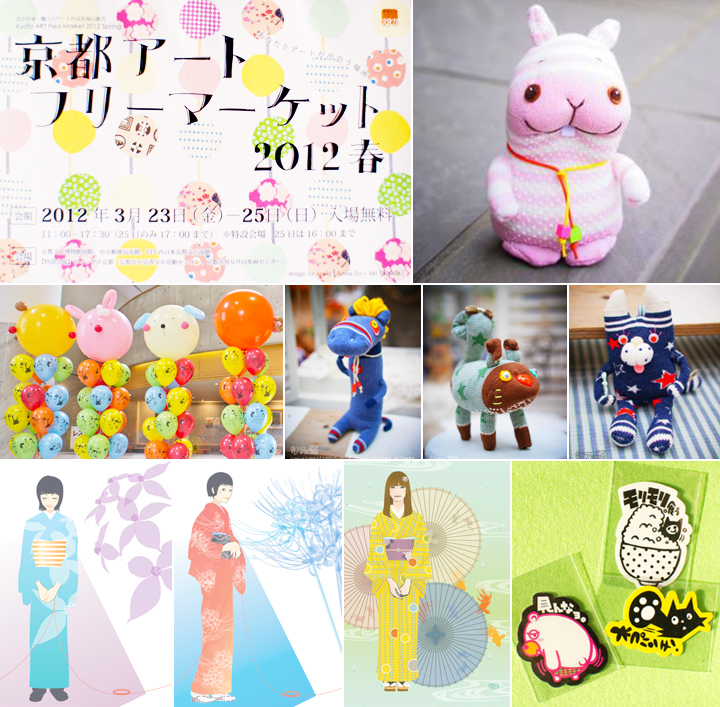
Charming Kyoto Art Flea Market at Nakagyō-ku


Nakagyō-ku in Kyoto is a lovely and somewhat hip neighbourhood anyone visiting Kyoto should try not to mis. This weekend the charming 'Kyoto Art Flea Market 2012' was organized throughout some of the streets and buildings there. Due to the rain the artists that would have been showing and selling their wares outside chose wisely and chose other activities for the day. But there was enough to see inside, even the better for visitors and vendors alike. But not to worry, there were four buildings left filled with creative abundance to enjoy. Buildings of quite different atmosphere, the Museum of Kyoto (the former Bank of Japan) being worth a look by itself.

The quality of the creative work was not always to my taste, but there were enough actual treasures to be found. And some artist had such downright cute items, you would just want to take your suitcase and fill it up! Regularly not a sock puppet devotee, one can not look at the works of 55pup, by Shizuka Okihara and not be charmed by their kawaii-ness* and skill. I think Okihara san has brought the Sock puppet to a higher plane with the detail and cleverness she puts in to her characters. And I would never have thought to write something about sock puppets in my life! :)

Another artist that grabbed my attention was Kojiro Tanaka with an overwhelming amount of great illustrations, printed as card or original art work. Tanaka san depicts the modern Japanese (Kyotite) young women as you can see them in Kyoto making their way gracefully through the streets in traditional kimono, with a new age twist.
Other artists showed  beautiful leather goods, bags, woodwork, ceramics, jewelry and other accessories, clothing, stickers and shoes even. Enough to fill a few hours. Except for the weather, a heartwarming event, not in the least because of the enthusiasm and openness of the artists attending.
*Kawaii means cute in Japanese

Visit the 55pup website for more rocking sock puppets by Shizuka Okihara
Visit Kojiro Tanaka's website for more charming illustrations
Thank you both for giving me permission to use your images!

Sunday, 25 March 2012

Bonsai in Japan, the best of the very best


This weekend, I have been told, Japan showed the best of the very best Bonsai trees at the Shohin Bonsai Fair (Shunga-ten or 春雅展). It is a yearly exhibition, held in Osaka at the end of March in the Mizu no Yakata dome.

As I was seeing quite some trees without leaves, I tried to investigate why the 'All Japan Shohin-Bonsai Association' (AJSBA) chose to exhibit such exquisite specimen not a little later in the year, when all the trees would have their leafs? The very kind Mr. Simmons, bonsai student and whom I met at the Fair, was happy and patient to give me a quick masterclass at the premises (my gratitude Mr. Simmons!).
So why March? Well, that one was the easiest; all deciduous trees should be exhibited without their leafs, because at that moment their form, the stalk and the branches, can be appreciated at their best. Which would be less easy if the trees are shown with their full foliage.

Another thing I learned is that bonsai have three 'classes'. These Shohin trees fall in the middle class and are 20 centimeters high. Sometimes they are 25 cm high, but these trees are only accepted if they are from a very high quality. The smallest group is called Mame Bonsai and these trees are not bigger than 12 centimeters. The biggest class of bonsai is called Chuhin.

The next thing that made me curious were the white 'dead' branches I saw protruding from the pine trees exhibited. You see an example of this at the bottom picture in the middle. These white parts are called shari (if the stem of the tree is intended) or jin (if the branches are intended). Shari and jin depict the bones of Buddha and make the tree seem very old. Because that's what's it all about for the bonsai grower and viewer of this art form.
Another sign that a tree is (or seems) very old is moss on the bed of the container and specially on the base of the tree (nebari) and the bark. Also, a crackled and grayish bark on the stem is of high value. And all this comes with decades of preening and patience, a few generations of patience even. Some of the trees at this exhibition were over a hundred years old and are passed on from grandfather to father to son.

Most of the trees did not have any wire showing, or other devices to keep the branches in place. This means that most of the trees were 'finished'. So the stem and all the branches of these trees have their perfect form and are 'only' to be contained this way. But that sounds easier said than done. Even keeping a tree in it's intended shape after it's finished is hard work an needs constant attention. I might add that some trees did show wire and thus had not yet reached their intended form. This is something that can also be appreciated as part of the art form. An art that is now a thousand years old already.

Since taking pictures is strictly prohibited, you should actually try and take a look yourself. The proud grower, in the picture, was very friendly and let me take a photo of his bonsai trees, and no doubt decades of hard work. His name is Hidehiko Nitta (ありがとうNitta san!). Also want to 'meet and great' and enjoy the best bonsai Japan has to offer? Maybe see you next year!

Wednesday, 21 March 2012

Tō-ji Temple 'Flea' market, for fingerlickin' Japanese souvenirs


Sometimes, often in Japan, my brain feels like it's short circuited by all the items of beauty I see everywhere. Wether these are new and modern items, or ancient and brimming over with tradition. They appeal to me in equal amount, huge amounts. The market at Tō-ji temple, the 21st of every month, is a place where my brain has quite some trouble to process all (choices between) the exquisite products for sale. It is, therefore, a huge market. It covers the complete temple grounds. I tried to find the exact acreage, but that stays a secret as yet.

The market is not fairly called a 'flea' market, offering amazing antiques, art, beautiful ceramics, bamboo baskets, vintage kimono's and accessories, all sorts of dried and freshly prepared kinds of food, varied kinds of hand made and creative items which the makers sell themselves, but also tools, toys, plants and even bikes for instance. It's just too much to sum up! And it's all very good quality from what I've been able to cover. But I'm afraid I haven't seen half of it. You can easily spend a day there.

Who cares that Tō-ji Temple is an Unesco World Heritage Site? Who cares that is was founded in the late 700's, and that it's grounds contain the the tallest pagoda in Japan? Get your behinds to the Tō-ji temple, whenever you can, for a great day out and fingerlickin' Japanese souvenirs or snacks. And get there early, because it's gonna be maaaayor busy!

At the moment Tō-ji Temple has a beautiful website, but unfortunately it's all in Japanese. Let's hope that will change in the near future.

Sunday, 18 March 2012

'Hanatouro' 10th anniversary of the Higashiyama light festival

Higashiyama is a traditional neighborhood breathing culture and history since the 14th century. It surrounds the famous temple of Kiyomizu dera and the Shoren-in temple at he eastern side of Kyoto. Every year a Light festival, called Hanatouro, is organized, this year celebrating it's 10th anniversary.

From March10th till March 20th, thousands of tourists enjoy the famous 5 km long route lined with approximately 2400 lanterns and large ikebana displays (Japanese flower arrangements). Many of the temples and shrines along the route invite you for their evening openings to watch special light displays. There is so much to see, one evening would not be enough to see it all. I expected long lines of waiting tourists at the temples, but the 'touro' seems to spread out so far, it can contain all those couples in love, families, photographers(!) and other visitors easily. I visited two temples and their gardens and one light show and didn't have to wait more than two minutes each time.

First I paid the Shoren-in temple a visit, founded in the 12th century, which has a beautiful garden with waterfall, bamboo grove and amazing buildings on the premises. In the garden tiny little blue lights turned on and of every few minutes, just like fireflies. Beautiful!

The second visit was to the Yuzen-en garden of the Chion-in temple. A huge temple complex, with a lovely little garden with a great karesansui (dry rock garden), modestly illuminated. Surprisingly, after a visit to this sacred place that was established some 700 years ago, each visitor gets complimentary Mc Donald's vouchers at the exit! What a strong contrast. :)

The most amazing show I've seen was beamed on the San-mon Gate (built in 1619), leading to the Chion-in temple. An almost 12 minute long light show made use of the intricate pattern of the huge gate which is 24 metres high and 50 metres wide. Colour patterns, lines, birds and other creatures moved over the immensely huge gate with such splendor, it was absolutely mesmerizing and and amazing end to a magnificent evening.

Friday, 16 March 2012

Manga Museum exhibits 'Magnitude Zero: March 11 seen through the eyes of comic artists from all over the world'

(image by Boulet, France)

Jean-David Morvan, a comic artist from France, had just visited Japan for the International Manga Awards. Back in France he had to learn from the news that a three fold disaster struck the country he came to be so fond of.

Immediately after he learned the terrible news he started 'Tsunami'. A project in which comic artists from over the world bundle their talent and skills to raise money for a relief fund for the victims of 11.03.11. Thousands of artists and illustrators responded by sending their original works to help Japan. Fifty of those original art works were auctioned and brought in 30.000 euro for the relief fund. Also 250 illustrations were selected for a book called 'Magnitude 9' which was published in September 2011. Already 4000 copies are sold today.

From March 3 to May 6 (2012) the Manga Museum at Kyoto exhibits a number of 120 illustrations from the Tsunami project called 'Magnitude 0'. The zero signifies Japan's northern region starting from 'scratch'.

Of course I've seen and read, the shocking and sad stories and video's from the victims of the Tohoku region. And now we see them again, just as shocking and heartbreaking, since the first anniversary is just a few days ago. I was deeply moved and impressed by the exhibition 'Magnitude 0' at the Manga Museum yesterday. It broke my heart to see, so graphically told, that even so soon after it happened, the Japanese people began to mend what was mendable. Helped by each other, but also strengthened by the hart felt messages and help from other countries, they will continue to rebuild their lives again.

If you have the chance, visit the Kyoto International Manga Museum. If you don't have the opportunity, here's a link to the Magnitude 9 website, for more awe-inspiring art work.

The image that illustrates this article is by the very kind mr. Boulet (France). Merci beaucoup monsieur Boulet!


Sunday, 11 March 2012

The 66 traditional crafts of Kyoto: A review of Fureaikan


I did not know what to expect from the Kyoto Museum of Traditional Crafts (Furaikan in Japanese). The information online is, well let's say, mysterious. Since it's also the week of Traditional Crafts I thought there would be a temporary 'stall' and not a complete museum. But that was indeed what I found.

If you would look for anyone carrying a warm hart for the traditional arts of Japan, I think you would find a picture of me (tried Googling already?). In that aspect my hopes were maybe a bit high for the museum, to be honest.
Every point of criticism aside, you can not visit this place and not be in awe of all 66 traditional crafts that are still performed in Kyoto to this day! Many are only performed in Kyoto with techniques that didn't change since the beginning of their craft.

Even so, I think it's not unfair to say that the museum lacks 'spirit' and 'atmosphere'. That the museum is situated in the Miyako Messe does not help in the first place. As the picture so painfully demonstrates. It would be so much more fitting to for this 'topic' to one of Kyoto's old but vibrant neighborhoods with low, wooden buildings and sliding doors.
And, indeed, every Sunday there is a Seasonal Dance performed by real Maiko (student Geisha) and every day artists demonstrate their crafts. I've seen at least seven artisans working on their tatami mats, hunched and crafting away. Only one of them seemed inclined to tell a bit about what she was doing. The expected language barrier does not help, I understand, but some friendly recognition of your existence would make visitors feel more welcome. Specially because there were only about three other visitors at the time.

So why were there so few people visiting Furaikan? Well, even though in their own brochure they say Furaikan is the place 'Craftsmen techniques and the beauty of traditions are Alive today', it doesn't feel that way. And the 'NO PHOTOS!' signs, not even from the demonstrations, are not very welcoming. Pictures that would have been great to add to this post to pass on the interesting side of visiting the museum.
Maybe it helps to enthuse to know that the admission is free, you WILL learn something and if you did not like it, there are many other interesting things to visit in the direct vicinity.


Here is a link to the website of Fureaikan.


And a list of the 21 most interesting traditional crafts shown at Fureaikan:
(in order of appearance)

Kyo-Ishi-Kogeihin - Stonework
Zoen - Landscape gardening
Fusa-Yorihimo - Tassels
Nishijin-Ori - Woven Cloth
Tabi - Tabi footwear
Hana-Kanzashi - Ornamental hairpins
Tsuge-Gushi - Combs
Kyo-Meichiku - Bamboo
Wagasa - Bamboo & Japanese umbrella's
Chochin - Paper Lanterns
Harikago - Bamboo boxes
Take-Kogei - Bamboo craftwork (e.g. baskets)
Kyo-Sudare - Bamboo blinds
Kyo-Sensu - Folding paper fans
Kyo Yaki/Kiyomizu-Yaki - Ceramics
Kyo-Sikki - Laquerware
Kyo-Hanga - Woodblock prints
Kogei-Gashi - Confectionary
Nihonshu - Japanese sake
Zogan - Inlaid ivory work
Kirigane - Goldleaf work

Thursday, 8 March 2012

Picture dream opportunity; a taxi driver tries to take the stairs!


Strolling through town with my camera at the ready I never actually dreamed of an opportunity like this! At the Higashi Hon Ganji temple a taxi driver scratches his head while a man of the Japanese AA tries to pry his car loose from the temple stairs, with danger to his own safety it seemed to me. Imagine what a shock it must have been for him, and his 'load'! The onlookers thought it all quite funny though and of course many cell phones whirred also into action :)

Tuesday, 6 March 2012

Ikenobo Society celebrates it's 550th year


At the Takashimaya department store, Osaka. The Ikenobo Society celebrates it's 550th year of (recorded) existence. That is since 1462 AD! And a very special society it is. The initiates have their own language I understand, a lingo which not many outsiders can understand. It is the way of flowers. That is what ikebana means, this Japanese way of flower arranging.
And Ikenobo is the oldest 'school' amongst many, with it's roots in Kyoto, where they even have their own temple. The Rokkaku-dō (六角堂) for which the official name is Shiun-ji or Purple Cloud Temple (紫雲寺). Over 2000 different schools exist today, that have been established since the first one was founded by a priest. The teaching learns for one  that the flower stems represent hills, waterfalls, valleys, and other objects of nature, which should be arranged in a specific way. It is an art form still taught in schools, and very often you may find such arrangements in glass show cases at train stations and other public buildings.

And from next week I hope to be included in this mysterious world of rules and regulations. I'm taking Ikenobo lessons. From a Japanese Ikenobo master. Who does not speak English… and I just speak a few words of Japanese. In the sense that I can order a cup of tea. Although, this not an easy task in this tea-soaked-country, I've found. But that is a whole other topic for a whole other blog post.
Maybe it is just as well that we cannot communicate with words. We will communicate through the way of the flower.

But, back to the celebration of the Ikenobo Society at Takashimaya. Quite crowded. Specially with well 'coiffed' elderly ladies, make-up applied with vigour and sometimes dressed in traditional kimono. Armed with their mobile phones, and sometimes an actual camera they snap away and talk quietly together about the beautiful arrangements (which sometimes gets praised loudly with a very Japanese 'oooooh!') and probably also the missteps that have been made. Although we might never know.

Powdered and serious ladies aside, the exhibition was astounding. I've been to four Ikenobo events before. This one was not the absolute best, but absolutely gorgeous it was. And I want to be able to perform this very hard-earned, very severely schooled and quite ancient art myself. Let's hope I can find the way of flowers myself.

Saturday, 3 March 2012

Girl's Day at Shimogamo Shrine

Never before had I spent a day in Japan (79 days all in all, till now) where I was in the middle of such an excited, carefully but certainly pushy crowd. Never too sure about the information found on Japanese websites either (even so thank you Sergey & Larry for Google translate), today I knew I must be in the right place.

March 3rd is a festive day in Japan, specially for girls. This day the Hinamatsuri (Dolls Festival) is celebrated, which is also called Girls Day. Families celebrate and pray for health, happiness and a strong marriage for their young daughters. And today these families visiting Shimogamo Shrine in Kyoto were excited!

Their daughter's futures hang in the balance at such a day and Hina dolls are an important part of it. A few days before the festival, mothers and their daughters make a display at home of the dolls the family has gathered over the years. The 'stage' for the hina dolls can be extended to quite a few, including accessories. These proud displays can cost them thousands of yen. The main dolls in the display, though, are the Emperor and the Empress. So one can start small. Fortunately, one would like to add, for the less prosperous little ones.

Part of the celebration of Girls Day is done by 'Nagashi Bina'. A special ceremony where small hina dolls in their boats made of straw are released on a stream or at sea. Hundreds of people gathered to join or watch the boats flow away. And to add to the festivities, a demonstration was held where a girl was dressed as an original hina doll in twelve layers of kimono! Just like the Genroku-bina doll, she was dressed in a court costume of the Heian period (794 to 1185). Every layer was tied with a knot around her waist to keep everything in place, which would be released after the next layer was added. The last two layers were more elaborate and colorful. These robes must have weighed quite a few pounds on this poor girl, but she was unfased by all the plucking and gentle tucking of the two women dressing her and the heavy garments (and temperature!) she had to endure. A perfect picture of serenity and calmness on this perfect spring day on March 3rd.